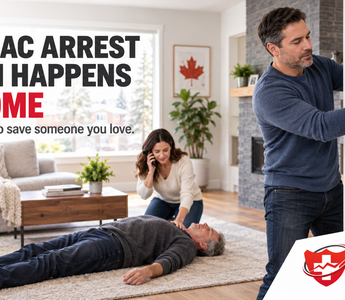
Why Having an AED at Home Could Save Someone You Love or Yourself
When people think about automated external defibrillators, they often picture AEDs mounted in airports, schools, arenas, workplaces and community centres. But cardiac arrest frequently happens somewhere much more personal: at home.
Approximately 70% of out-of-hospital cardiac arrests occur in homes or private residences, according to American Heart Association data. In Canada, an estimated 60,000 cardiac arrests occur outside hospitals every year—approximately one every nine minutes.
When cardiac arrest happens at home, the person who collapses may be your spouse, parent, child, relative, neighbour or close friend. Having an AED only a few steps away could give you the opportunity to act before paramedics arrive.
What Happens During Sudden Cardiac Arrest?
Sudden cardiac arrest occurs when the heart unexpectedly stops pumping blood effectively. The person will typically:
-
Collapse suddenly
-
Become unresponsive
-
Stop breathing normally or begin gasping
-
Have no detectable signs of circulation
Cardiac arrest is not the same as a heart attack. A heart attack is generally caused by an interruption in blood flow to the heart muscle. Cardiac arrest is usually an electrical problem that prevents the heart from pumping blood to the brain and other vital organs.
Without immediate treatment, cardiac arrest can become fatal within minutes.
Why Waiting for an Ambulance May Not Be Enough
Calling 911 is always essential, but cardiac arrest requires action while emergency medical services are on their way.
Every minute without CPR and defibrillation reduces the likelihood of survival. Even an excellent emergency-response system cannot place paramedics inside every Canadian home within the first critical minutes.
That is why bystanders are so important.
CPR helps circulate a limited amount of oxygenated blood to the brain and heart. An AED analyzes the person’s heart rhythm and, when appropriate, delivers an electrical shock intended to help restore an effective rhythm.
CPR buys time. An AED may help restart the heart. Both are critical parts of the emergency response.
A Real Home-AED Rescue: Tim and Liz’s Story
Tim McEnery understood the importance of AED preparedness through his business. After installing AEDs and arranging CPR training at his restaurants, he decided that protecting his customers and employees was not enough. He also wanted to protect his family.
Tim purchased an AED for his Chicago-area home and kept it there for approximately 10 years without needing it.
Then, in 2023, that decision helped save his fiancée’s life.
Tim and his fiancée, Liz Brumm, were sitting together on their couch watching a movie when Tim heard an unusual sound. He initially thought it came from the television, but then realized that Liz had slumped forward.
She was not breathing. Her heart had stopped.
Tim called 911, began CPR and told the dispatcher that he had an AED in the house. He retrieved the device, attached the electrode pads and followed its voice instructions. The AED analyzed Liz’s heart rhythm and advised a shock.
Tim continued CPR and ultimately delivered three AED shocks before paramedics arrived and took over.
Liz survived, recovered and was able to leave the hospital. Doctors later determined that she had an arrhythmia that ran in her family.
Tim had purchased the AED years earlier, hoping he would never need it. After the rescue, he explained that without the AED, he believed he would have been sitting there alone.
Their experience demonstrates an important truth: an AED cannot help if it is too far away to be retrieved during the first critical minutes.
Can an Ordinary Person Use an AED?
Yes. Modern AEDs are designed for use by members of the public, including people without medical training.
Once activated, an AED provides step-by-step voice and visual instructions. It analyzes the person’s heart rhythm and determines whether a shock is appropriate. The rescuer does not make that medical decision, and the AED will not advise a shock unless it detects a shockable rhythm.
CPR and AED training are strongly recommended because training can improve confidence and reduce hesitation. However, an untrained person should still use an available AED during a suspected cardiac arrest and follow its prompts.
Learn more in our step-by-step guide to using an AED.
Who Should Consider Buying an AED for Their Home?
Any Canadian household can consider purchasing an AED. It may be particularly valuable when:
-
Someone in the household has a known heart condition or elevated cardiac risk
-
Older adults live in or frequently visit the home
-
There is a family history of cardiac arrest or dangerous arrhythmias
-
The home is in a rural or remote location
-
Ambulance response could take longer
-
Several generations regularly gather at the property
-
The family spends significant time at a cottage, farm or recreational property
-
Household members want an additional level of emergency preparedness
A known heart condition is not required for cardiac arrest to happen. Some people experience cardiac arrest without a previous diagnosis or clear warning.
Anyone concerned about their personal cardiac risk should speak with a qualified healthcare professional. A home AED provides emergency-response capability, but it does not replace medical assessment, treatment or prevention.
Choosing an AED for Home Use
A home AED should be straightforward, dependable and easy for family members to use under stress. Features worth considering include:
-
Clear voice and visual instructions
-
CPR coaching or real-time CPR feedback
-
Adult and child rescue capability
-
Easily understood readiness indicators
-
Long-life batteries and electrode pads
-
A strong manufacturer’s warranty
-
Bilingual English and French instructions when appropriate
-
Reliable access to replacement pads and batteries in Canada
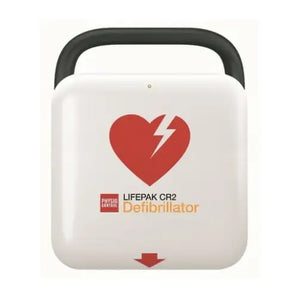
AED.ca supplies Health Canada-authorized AEDs from trusted manufacturers, including the Physio-Control LIFEPAK CR2 AED
You can also compare AEDs available in Canada or contact AED.ca for help selecting an appropriate device for your household.
Where Should You Keep a Home AED?
Store the AED in a location that is:
-
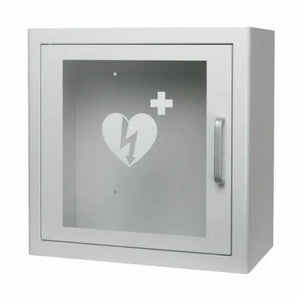
Visible and easy to reach
-
Known to everyone in the household
-
Accessible without a key or combination
-
Protected from extreme heat, cold and moisture
-
Away from clutter that could delay retrieval
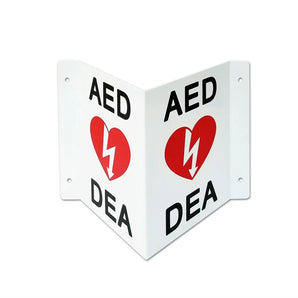
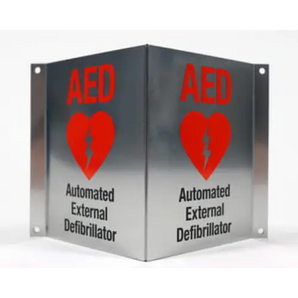
Do not bury it in a closet, lock it in a cabinet or leave it somewhere family members do not know about. During cardiac arrest, every second matters.
Make sure everyone in the household knows where the AED is stored and understands that it should be brought immediately whenever someone is unresponsive and not breathing normally.
A Home AED Must Be Maintained
Buying an AED is only the first step. Electrode pads expire, batteries eventually require replacement and the device’s readiness indicator must be checked regularly.
Your home-AED plan should include:
-
Regularly checking the readiness indicator
-
Monitoring pad and battery expiry dates
-
Replacing expired or used supplies
-
Keeping a rescue kit with the AED
-
Reviewing the device’s instructions
-
Practising your household emergency plan
-
Ensuring child pads or a child-rescue mode are available if needed
An AED is only valuable during an emergency if it is accessible, properly equipped and ready to operate.
What to Do During a Suspected Cardiac Arrest
If someone suddenly collapses and is unresponsive and not breathing normally:
-
Call 911 immediately and place the phone on speaker.
-
Send someone to retrieve the AED, if another person is present.
-
Begin CPR, following the dispatcher’s instructions.
-
Turn on the AED and attach the pads to the person’s bare chest as shown.
-
Follow every AED prompt and ensure no one is touching the person during rhythm analysis or shock delivery.
-
Resume CPR immediately when instructed and continue until the person responds or emergency responders take over.
Never delay calling 911 or beginning CPR while looking for an AED.
An AED Is Emergency Protection for the People Who Matter Most
Families install smoke alarms and keep fire extinguishers even though they hope never to use them. A home AED can be viewed in much the same way.
Most of the time, it will remain stored and ready.
But if someone you love experiences cardiac arrest at home, immediate access to an AED could make the difference between waiting helplessly and having the ability to act.
You cannot predict when cardiac arrest will happen. You can decide whether your home is prepared.
Shop AEDs for home use in Canada, call AED.ca at 1-833-428-3233, or email info@aed.ca for personalized assistance choosing an AED for your family.
Sources: Heart & Stroke Foundation of Canada; American Heart Association; Mayo Clinic – Home AED guidance; documented Tim McEnery and Liz Brumm rescue story.