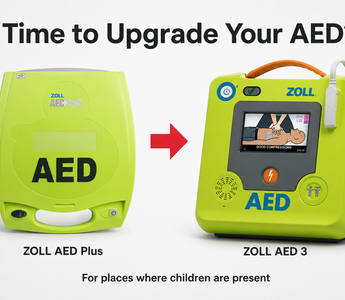
Upgrade to a Zoll AED 3
For schools, daycares, medical clinics, dental offices and other places where children are regularly present, upgrading from the ZOLL AED Plus to the ZOLL AED 3 can simplify emergency response. Its biggest advantage is one set of electrode pads for both adults and children, with an integrated child-mode button that eliminates the need to connect separate pediatric pads.
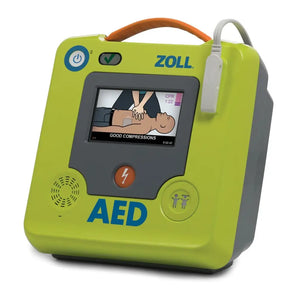
At AED.ca, we recommend considering this upgrade wherever young children spend time. The ZOLL AED 3 also offers enhanced visual guidance and connected readiness reporting, providing additional reasons to review your current AED.
1. One Set of Pads for Adults and Children
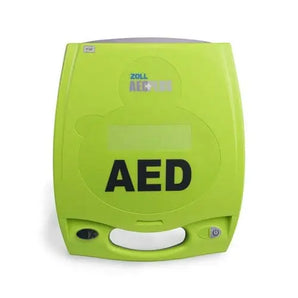
A pediatric-capable ZOLL AED Plus uses separate Pedi-padz II electrodes for young children. If adult pads are connected, the responder needs to locate and connect the pediatric set.
The ZOLL AED 3 uses CPR Uni-padz for both adults and children. The responder activates child mode and positions the pads according to the pediatric illustrations and device instructions.
For a business or organization that welcomes children, removing that pad change is a practical reason to upgrade. It reduces the equipment changes a responder must manage during an already stressful situation. ZOLL’s universal pad information.
Follow the supplied instructions for child-mode eligibility and pad placement. ZOLL’s administrator’s guide identifies child mode for patients under eight years old or weighing less than 25 kg (55 lb). ZOLL AED 3 administrator’s guide.
2. Fewer Pad Expiry Dates to Manage
An AED Plus prepared for adults and children requires two types of pads:
-
Adult CPR-D-padz: five-year shelf life.
-
Pediatric Pedi-padz II: two-year shelf life.
These different replacement schedules create an additional maintenance responsibility. ZOLL electrode specifications.
The AED 3’s universal pads have a five-year shelf life and cover both patient groups. This eliminates the separate pediatric pad purchase and replacement cycle. Always follow the expiry date printed on the package and replace pads after use.
For facilities maintaining pediatric coverage, this can reduce consumable costs and simplify inventory management. Total ownership costs still depend on the purchase price, replacement supplies and servicing.
3. Clearer Visual Guidance During a Rescue
Both the AED Plus and AED 3 provide Real CPR Help feedback for adult CPR. The AED 3 builds on this with:
-
A full-colour display.
-
Rescue illustrations.
-
A CPR cycle timer.
-
A visual compression-depth gauge.
These features can help responders follow the rescue sequence and interpret feedback alongside the voice prompts. This is useful for staff or volunteers who may never have used an AED in an actual emergency. ZOLL AED 3 features.
The AED 3’s compression-depth feedback is disabled in child mode. Its pediatric advantages are the universal pads and integrated child mode; adult depth coaching should not be confused with pediatric feedback.
4. Connected Readiness Reporting
When configured with compatible Wi-Fi and an appropriate AED management service, the AED 3 can report readiness status and failed self-tests remotely.
For organizations managing multiple clinics, schools, offices or recreation facilities, this can help staff identify problems requiring attention.
Setup and any service requirements should be confirmed when purchasing. Connectivity supports regular physical inspections; it does not replace them.
5. An Opportunity to Review an Ageing AED
If your AED Plus is older, has an uncertain maintenance history or is approaching a significant replacement-parts purchase, it is a good time to compare continued maintenance with an upgrade.
AED.ca can help assess its age, condition, pediatric capability and suitability for your facility.
A properly maintained, pediatric-capable AED Plus with the correct pads can still be a suitable device. An upgrade should reflect your organization’s needs and the condition of its equipment.
Which Businesses and Facilities Should Consider Upgrading?
The benefits extend beyond schools and daycares. Any organization where young children regularly visit, receive care or participate in activities should consider how easily its AED can support both adult and pediatric rescues.
Examples include:
-
Medical facilities: family doctors’ offices, walk-in clinics, pediatric clinics, community health centres and outpatient facilities.
-
Dental practices: general dentists, pediatric dentists, orthodontists and oral surgery clinics.
-
Other healthcare providers: physiotherapy clinics, chiropractic offices, optometry practices and pharmacies.
-
Education and childcare: elementary schools, daycares, preschools, tutoring centres and after-school programs.
-
Churches and community organizations: places of worship, community centres and organizations offering children’s programs.
-
Sports and recreation: swimming pools, arenas, gyms with childcare, gymnastics clubs, dance studios and martial arts schools.
-
Camps and family attractions: summer camps, campgrounds, indoor playgrounds and amusement facilities.
-
Hospitality businesses: hotels, resorts, restaurants and event venues that welcome families.
-
Retail and public spaces: shopping centres, grocery stores, libraries and other locations regularly visited by families.
-
Workplaces with visiting children: offices with on-site childcare, family events or customers who bring children to appointments.
Consider everyone who may be on site—not just employees or your primary customers. A dental office may treat both adults and children, while a medical clinic may welcome young patients and children accompanying a parent.
For these settings, the ZOLL AED 3’s universal pads and integrated child mode make it worth considering when reviewing or replacing an AED Plus. Healthcare facilities should also assess the device against their clinical protocols and any procedure-specific equipment requirements.
If you are updating the complete installation, explore our AED bundles and packages.
Keep Your New AED Rescue Ready
Upgrading your AED is only one part of maintaining an effective emergency response program.
Every AED needs ongoing attention, including correct pad and battery installation, scheduled readiness checks, expiry tracking and replacement after use when required.
AED.ca’s Full Service AED Maintenance Plan includes:
-
Annual on-site inspections and readiness checks.
-
Pad and battery replacement.
-
Digital maintenance records.
-
Automated expiry tracking.
-
Loaner AED support during servicing or downtime.
-
Access to AED specialists for ongoing support.
Whether you keep your existing AED Plus or upgrade to an AED 3, proper maintenance helps ensure your device is ready when needed.
Get Help Choosing the Right AED for Your Facility
The right AED should suit the people who use your building and the team expected to respond in an emergency.
For organizations where young children are regularly present, the ZOLL AED 3 offers a practical combination of universal pads, integrated child mode, enhanced visual guidance and connected readiness reporting.
Wondering whether it is time to replace your ZOLL AED Plus? Contact AED.ca for help evaluating your current device and deciding whether the ZOLL AED 3 is the right upgrade for your facility.
About AED.ca and Martin Andrews: AED.ca is a Canadian-owned AED specialist supporting organizations with AED sales, inspections and maintenance. Martin Andrews, President of AED.ca, focuses on helping make AEDs more accessible and keeping them ready when needed.