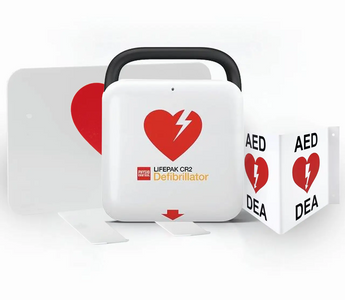
A Simple Guide to (AEDs) Automated External Defibrillators
An AED (Automated External Defibrillator) is a portable medical device used to help someone experiencing sudden cardiac arrest. An AED analyzes the person's heart rhythm and determines whether an electrical shock is needed. If appropriate, it can deliver a shock to help the heart return to an effective rhythm.
AEDs are designed to be used by ordinary people, not just healthcare professionals. The device provides voice and/or visual instructions that guide the rescuer through the emergency.
In Canada, AEDs can be found in workplaces, schools, recreation facilities, churches, gyms, offices, public buildings and many other locations.
Quick answer: If someone suddenly collapses, is unresponsive and is not breathing normally, call 9-1-1, begin CPR, get an AED and follow its instructions.
What Does AED Stand For?
AED stands for Automated External Defibrillator.
Here's what each word means:
| Term | Meaning |
|---|---|
| Automated | The AED automatically analyzes the heart rhythm and determines whether a shock is appropriate. |
| External | Electrode pads are placed externally on the person's bare chest. |
| Defibrillator | The device can deliver an electrical shock when it detects a heart rhythm that can be treated with defibrillation. |
In simple terms, an AED is a portable defibrillator designed to help treat sudden cardiac arrest.
What Does an AED Do?
An AED analyzes a person's heart rhythm during cardiac arrest and determines whether an electrical shock is needed.
The person using the AED does not decide whether to shock the heart.
The AED does that.
Health Canada describes AEDs as portable devices that analyze a person's heart rhythm, determine whether a shock is needed and use voice or screen prompts to guide the rescuer.
If the AED detects an appropriate shockable rhythm, it will either instruct the rescuer to press a shock button or, with a fully automatic AED, deliver the shock automatically after warning people to stand clear.
If a shock is not appropriate, the AED will not advise or deliver one.
What Is Sudden Cardiac Arrest?
Sudden cardiac arrest occurs when the heart suddenly stops pumping blood effectively to the brain and other vital organs.
Someone experiencing cardiac arrest may:
-
Suddenly collapse
-
Become unconscious
-
Be unresponsive
-
Stop breathing normally
This is a medical emergency.
Heart & Stroke estimates that approximately 60,000 out-of-hospital cardiac arrests occur each year in Canada — about one every nine minutes.
Heart & Stroke also reports that performing CPR and using an AED can double a person's chance of survival.
That is why rapid access to an AED matters.
How Does an AED Work?
An AED works by using electrode pads placed on the chest to analyze the heart's electrical activity and determine whether defibrillation is appropriate.
The process generally involves five steps:
1. Turn on the AED
Turn the AED on and listen carefully.
Modern AEDs provide spoken and/or visual instructions that guide the rescuer through the process.
2. Attach the AED Pads
Expose the person's chest and attach the electrode pads exactly as shown in the diagrams on the pads.
3. Allow the AED to Analyze the Heart
The AED automatically analyzes the person's heart rhythm.
Nobody should touch the person while the AED is analyzing.
4. Follow the Shock Instructions
If a shock is appropriate, the AED will tell you.
With a semi-automatic AED, the rescuer presses the shock button when instructed.
With a fully automatic AED, the device can deliver the shock automatically after warning everyone to stand clear.
5. Continue CPR
Resume CPR immediately when instructed and continue following the AED and 9-1-1 dispatcher's directions until emergency medical services take over or the person's condition changes.
How Do You Use an AED?
To use an AED, call 9-1-1, begin CPR, turn on the AED, attach the electrode pads to the person's bare chest and follow the AED's instructions.
A simple sequence to remember is:
-
Call 9-1-1.
-
Start CPR.
-
Get the AED.
-
Turn it on.
-
Attach the pads as shown.
-
Stand clear while the AED analyzes.
-
Deliver a shock if instructed.
-
Immediately resume CPR when instructed.
You do not have to diagnose the person's heart rhythm yourself.
The AED does the analysis for you.
Can Anyone Use an AED?
Yes. AEDs are designed so members of the public can use them.
Heart & Stroke states that anyone can use an AED and that you do not need to be a medical professional.
AEDs provide step-by-step instructions and automatically determine whether a shock is appropriate.
CPR and AED training is still highly recommended because training can improve confidence and preparedness during an emergency.
Can You Accidentally Shock Someone With an AED?
An AED is designed to deliver or permit a shock only when it detects a heart rhythm that is appropriate for defibrillation.
The AED analyzes the heart before a shock can be delivered through its normal operating sequence.
The rescuer does not make the medical decision.
This built-in analysis is one of the most important safety features of modern AEDs.
Does an AED Restart a Stopped Heart?
Not exactly. An AED does not simply “restart” a completely stopped heart like jump-starting a car.
An AED analyzes the heart's electrical rhythm and delivers a shock when it detects certain abnormal rhythms that can be treated with defibrillation.
The goal of the shock is to interrupt the dangerous electrical activity so an effective heart rhythm can potentially be restored.
AED vs. Defibrillator: What's the Difference?
An AED is a type of defibrillator specifically designed to automatically analyze the heart rhythm and guide the rescuer.
| Term | What It Means |
|---|---|
| AED | Automated External Defibrillator designed for rapid emergency use |
| Defibrillator | Broad term for medical equipment that can provide electrical therapy to the heart |
| Portable defibrillator | Often another way people describe an AED |
| AED machine | Common informal term for an AED |
| Automatic defibrillator | May refer to a fully automatic AED |
| Semi-automatic AED | User presses the shock button when instructed |
| Fully automatic AED | AED delivers the shock automatically when appropriate |
When Canadians search for AED, AED machine, portable defibrillator, heart defibrillator or defibrillator for a workplace, they are often looking for an Automated External Defibrillator.
Where Are AEDs Used in Canada?
AEDs are commonly placed anywhere people live, work, exercise, gather or participate in activities.
Examples include:
-
Businesses and workplaces
-
Offices
-
Manufacturing facilities
-
Warehouses
-
Construction sites
-
Schools
-
Churches
-
Arenas
-
Recreation centres
-
Gyms
-
Hotels
-
Restaurants
-
Community centres
-
Municipal buildings
-
Condominiums
-
Sports facilities
-
Cottages and remote properties
Health Canada specifically notes that AEDs are installed in public locations across Canada, including hockey arenas and recreational facilities.
The purpose is to make defibrillation available as quickly as possible when sudden cardiac arrest occurs.
Why Is Having an AED Nearby Important?
Having an AED nearby can allow defibrillation to begin before paramedics arrive.
During cardiac arrest, every minute matters.
Heart & Stroke recommends three critical actions:
Call 9-1-1. Start CPR. Use an AED.
This is why AED placement should be considered part of an organization's overall emergency response plan rather than simply purchasing an AED and placing it somewhere in the building.
Are AEDs Safe?
AEDs are designed with safeguards that analyze the person's heart rhythm before allowing or delivering a shock.
Health Canada regulates medical devices sold in Canada, including AEDs.
Organizations purchasing an AED should make sure they are buying an appropriate device authorized for sale in Canada and should understand the manufacturer's operating and maintenance requirements.
Do AEDs Require Maintenance?
Yes. AEDs require regular checks and maintenance to help ensure they remain ready for an emergency.
Health Canada recommends that AEDs be checked regularly and that organizations follow the manufacturer's maintenance and testing instructions.
AED maintenance may include:
-
Checking the AED readiness indicator
-
Checking electrode pad expiry dates
-
Checking battery condition
-
Confirming pads and batteries are installed correctly
-
Addressing warning lights, beeps or service messages
-
Checking for physical damage
-
Confirming rescue accessories are present
-
Maintaining inspection records
-
Replacing pads and batteries when required
-
Checking the AED after use
Learn more in our guide to AED maintenance and inspections in Canada.
Do AED Pads and Batteries Expire?
AED electrode pads have expiry dates, and AED batteries have manufacturer-specified service or replacement requirements.
This is one of the most important parts of AED ownership.
An AED can remain unused for years, which sometimes gives organizations the impression that nothing needs to be done to it.
That's not the case.
Pads, batteries and the AED's readiness status should all be monitored according to the manufacturer's instructions.
Organizations should never assume an AED is rescue-ready simply because it has never been used.
Real-World AED Readiness: What AED.ca Sees in the Field
Buying replacement AED pads and batteries is not enough — they also have to be correctly installed.
AED.ca recently completed a maintenance visit at a Canadian organization that had already purchased replacement pads and batteries for its AED.
On the surface, everything appeared to have been taken care of.
There was one significant problem:
The replacement components had not been installed correctly.
As a result, the AED was not properly rescue-ready.
This illustrates something we see repeatedly in AED management: organizations often have good intentions but don't necessarily have someone internally who understands the specific requirements of every AED model.
An AED is emergency medical equipment.
The goal isn't simply to own one or purchase replacement parts.
The goal is to know that your AED is ready when someone needs it.
Who Should Be Responsible for an AED?
Every organization with an AED should designate responsibility for maintaining its readiness.
That responsibility can include:
-
Regular AED inspections
-
Pad expiry tracking
-
Battery monitoring
-
Correct installation of replacement components
-
AED accessibility
-
Inspection documentation
-
Manufacturer alerts
-
Service issues
-
Replacement after an AED is used
Managing this internally may be relatively straightforward with one AED.
Managing dozens or hundreds of AEDs across multiple locations can be much more complicated.
What Is AED.ca's Full Service AED Maintenance Plan?
The AED.ca Full Service AED Maintenance Plan is designed to help Canadian organizations professionally manage AED inspections, replacement components, documentation and ongoing rescue readiness.
The program currently includes:
-
Annual on-site AED inspection and readiness check
-
AED replacement pads when required under the plan
-
AED battery replacement when required under the plan
-
AED inspection documentation
-
Maintenance records
-
Pad expiry tracking
-
Battery expiry tracking
-
Loaner AED during covered servicing or downtime
-
AED registry support
-
Compliance and regulatory guidance
-
Priority access to AED specialists
Learn more about the AED.ca Full Service AED Maintenance Plan.
Where Can You Buy an AED in Canada?
AEDs can be purchased from Canadian AED suppliers, but buyers should compare more than the initial purchase price.
Before choosing an AED, consider:
-
Who will be using it?
-
Where will it be installed?
-
Is bilingual English/French operation important?
-
Will it potentially be used on children?
-
Is CPR feedback important?
-
How long do the pads last?
-
What is the battery replacement schedule?
-
What do replacement components cost?
-
How long is the warranty?
-
Who will maintain the AED?
-
What technical support is available after purchase?
You can shop AEDs in Canada from AED.ca or contact us for help selecting the right device.
What Is the Best AED?
There is no single AED that is best for every person, business or organization.
The best AED depends on the environment and how it will be used.
For example, different organizations may prioritize:
-
Bilingual operation
-
Pediatric capability
-
CPR feedback
-
Rugged construction
-
Ease of maintenance
-
Connectivity
-
Long-life pads or batteries
-
Simplicity of operation
At AED.ca, our approach is to understand the customer's situation first and recommend an AED we believe is appropriate for that application.
We don't believe organizations should buy an AED simply because it is the cheapest device available.
An AED is something you purchase hoping you will never need — but if you do need it, it needs to be a device you can depend on.
Frequently Asked Questions About AEDs
What does AED stand for?
AED stands for Automated External Defibrillator.
What is an AED?
An AED is a portable medical device that analyzes the heart rhythm during sudden cardiac arrest and can provide an electrical shock when an appropriate shockable rhythm is detected.
What does an AED do?
An AED determines whether a person's heart rhythm can be treated with defibrillation and guides the rescuer through the emergency.
Can anyone use an AED?
Yes. AEDs are designed so members of the public can use them. Heart & Stroke states that you do not have to be a medical professional to operate an AED.
Do I need AED training?
AEDs are designed to guide users through the rescue, but CPR and AED training is highly recommended.
Will an AED shock someone who doesn't need it?
AEDs analyze the person's heart rhythm and are designed to permit or deliver a shock only when an appropriate shockable rhythm is detected.
Can you use an AED on a child?
Many AEDs can be used for children, but the method depends on the AED model. Some use pediatric pads, while others use a pediatric mode, button, key or selector. Follow the manufacturer's instructions.
Do AEDs expire?
AED units have an expected service life, while electrode pads and batteries have specific expiry, standby-life or replacement requirements. These vary by manufacturer and model.
Do AEDs need maintenance?
Yes. Health Canada recommends regular AED checks and following the manufacturer's maintenance and testing schedule.
Do AEDs need to be inspected?
Yes. Regular readiness checks help identify expired components, battery issues, missing supplies, damage or service warnings before an emergency occurs.
What should I do after an AED is used?
Follow the manufacturer's post-use requirements and arrange to have the AED checked and restored to rescue-ready condition. Used electrode pads generally need to be replaced and other components may also require attention.
How much does an AED cost in Canada?
AED prices vary according to manufacturer, model, features and included accessories. Buyers should consider the total cost of ownership, including replacement pads, batteries, maintenance and service rather than comparing only the initial AED price.
Where can I buy an AED in Canada?
Canadian businesses, organizations and individuals can purchase AEDs online from AED.ca or speak with an AED specialist for assistance selecting a device.
AED: The Simple Answer
If you remember only one thing from this guide, remember this:
An AED — Automated External Defibrillator — is a portable medical device designed to help someone experiencing sudden cardiac arrest. It analyzes the heart rhythm, determines whether a shock is appropriate and guides the rescuer through what to do.
If someone collapses, is unresponsive and isn't breathing normally:
Call 9-1-1. Start CPR. Get an AED. Follow its instructions.
And if your organization already owns an AED, make sure someone is responsible for ensuring it remains properly maintained and rescue-ready.
Need Help With an AED in Canada?
AED.ca helps Canadian businesses, schools, churches, municipalities, workplaces, community organizations and individuals choose, purchase, maintain and manage Automated External Defibrillators.
Whether you need your first AED, replacement pads or batteries, help choosing the right AED, or a professionally managed maintenance program, our team specializes specifically in AED equipment and ongoing AED readiness.
Learn about AED.ca Full Service AED Maintenance
About AED.ca
AED.ca is a Canadian-owned AED company based in Barrie, Ontario, serving organizations across Canada. We specialize in Automated External Defibrillators, AED replacement supplies, inspections, maintenance and AED program support.
Our focus is straightforward: help Canadian organizations choose appropriate AED equipment and help keep those devices rescue-ready.
About Martin Andrews
Martin Andrews is President of AED.ca. Martin works with businesses and organizations across Canada to simplify AED purchasing, ownership and maintenance, with a particular focus on ensuring AEDs remain properly maintained and ready for an emergency.
Last reviewed and updated: August 2026.
Canadian Sources
This article was developed using information and recommendations from Health Canada and Heart & Stroke, together with AED.ca's practical experience working with AED equipment and Canadian organizations.