Are All AEDs Not Basically The Same?
When comparing AEDs in Canada, it can be tempting to choose the unit with the lowest purchase price. Every dollar matters—especially for small businesses, community organizations, churches and nonprofit groups.
However, an automated external defibrillator is emergency medical equipment that may one day be used to help save a life. The least expensive AED is not necessarily the best value, the easiest to use or the most economical device to maintain over its service life.
Before purchasing an AED, Canadian organizations should consider the device's technology, CPR guidance, shock-energy capability, adult and child operation, voice-prompt clarity, pad and battery costs, warranty, connectivity and ongoing support. Price should be part of the decision, but it should not be the entire decision.
Are all AEDs basically the same?
No. AEDs share the same essential purpose: analyzing a person's heart rhythm and delivering a shock when an appropriate shockable rhythm is detected. However, the way different AEDs guide the rescuer, support CPR, manage pediatric use and communicate their readiness can vary considerably.
Some lower-priced AEDs are built on platforms introduced many years ago. The Philips HeartStart OnSite and FRx, along with the original Defibtech Lifeline, are examples of established designs that have been available for a long time.
That does not mean an older-model AED is automatically unsafe or incapable of performing its intended function. It does mean buyers should understand that these devices may not include newer features now available on modern AED platforms. When purchasing a new life-saving device today, it is reasonable to ask whether saving a few dollars upfront is worth giving up features that could better support a rescuer during a stressful emergency.
Why does newer AED technology matter?
Sudden cardiac arrest is chaotic. The person responding may be frightened, may not have used an AED before and may struggle to remember their CPR training.
Newer AEDs can help by offering clearer visual instructions, better audio guidance, CPR coaching, adult-and-child functionality, longer-life consumables and remote readiness monitoring. These features do not replace CPR training or emergency services, but they can make an AED program easier to manage and the device easier to use.
Modern AED technology may provide:
-
Real-time CPR feedback
-
Clearer visual and voice instructions
-
Voice prompts that adapt to surrounding noise
-
Higher escalating shock-energy options
-
Simple adult-to-child mode changes
-
Pads that can be used for both adults and children
-
Longer pad and battery life
-
Wi-Fi or cloud connectivity for readiness monitoring
-
Improved self-testing and status reporting
-
Better long-term program-management options
The right features will depend on where the AED is placed and who is most likely to use it.
How does real-time CPR feedback from ZOLL help a rescuer?
CPR quality matters during sudden cardiac arrest. Simply telling a rescuer to perform CPR does not confirm that compressions are deep enough or being delivered at the proper rate.
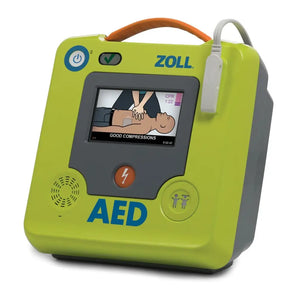
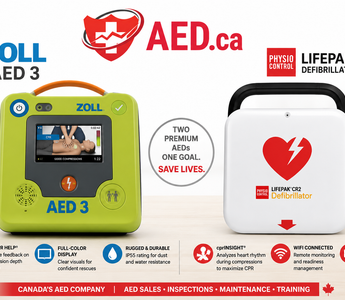
The ZOLL AED 3 offers enhanced Real CPR Help. Its full-colour display includes rescue images, a CPR cycle timer and a large colour bar that shows compression depth and rate. This provides the rescuer with real-time guidance and can help them adjust their compressions during the rescue.
The ZOLL AED 3 also uses CPR Uni-padz that can be used for both adult and pediatric patients. A rescuer can change to child mode without locating and installing a separate set of pediatric pads. Its pads and battery have a five-year shelf life, helping reduce replacement frequency and making long-term maintenance more predictable.
For schools, medical or dental offices, recreation facilities, community centres and other locations where children may be present, simplified adult-and-child operation can be an important consideration.
What makes the LIFEPAK CR2 different from many older AEDs?
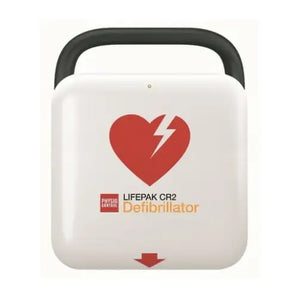
The bilingual LIFEPAK CR2 combines straightforward operation with several features intended to support a rescue in real-world environments.
Escalating energy up to 360 joules
The LIFEPAK CR2 can use an escalating adult-energy protocol of 200 joules for the first shock, 300 joules for the second and 360 joules for subsequent shocks. This gives the device the ability to deliver higher energy when configured to do so and when additional shocks are required.
Higher maximum energy does not mean every patient will require a 360-joule shock, nor does it guarantee a successful outcome. It is one capability to consider when comparing AED technology.
Voice prompts that adjust to background noise
An AED may be used in a loud gym, arena, factory, warehouse, school or public space. The LIFEPAK CR2 can automatically adjust the volume of its voice prompts based on ambient noise, helping rescuers hear its instructions when the surrounding environment is noisy.
Easy adult and child operation
The LIFEPAK CR2 allows the rescuer to switch between adult and child mode while using the same set of electrode pads. This can save valuable time and removes the need to locate separate pediatric pads during an emergency.
Bilingual capability and connected readiness
The bilingual English/French LIFEPAK CR2 is particularly well suited to Canadian workplaces and public locations. Wi-Fi connectivity can also support remote AED program management and readiness monitoring when properly configured.
Can a cheaper AED cost more to maintain?
Yes. The purchase price is only one part of the total cost of AED ownership.
Electrode pads expire and batteries eventually require replacement. Depending on the model, an organization may also need separate pediatric pads, a pediatric key or other accessories. Consumable shelf life and replacement pricing can therefore make a meaningful difference over the device's service life.
Before choosing an AED, compare:
-
The expected life and replacement cost of the electrode pads
-
The expected life and replacement cost of the battery
-
Whether separate pediatric pads are required
-
The manufacturer's warranty
-
The availability of replacement parts and technical support
-
Connectivity or monitoring fees, if applicable
-
The expected useful service life of the AED
-
Inspection, documentation and program-management requirements
An AED with a slightly higher initial price but longer-life pads and batteries may cost less to maintain over time. It may also reduce the number of expiry dates your organization must track.
Reliability involves more than the AED itself
Modern AEDs perform automatic self-tests, but no AED should simply be mounted on a wall and forgotten.
A rescue-ready AED program also requires someone to:
-
Check the device's visual readiness indicator
-
Confirm the pads and battery are correctly installed
-
Track pad and battery expiry dates
-
Replace used or expired supplies
-
Inspect the carrying case, rescue kit and cabinet
-
Maintain accurate inspection and service records
-
Monitor safety notices, recalls and software updates where applicable
AED.ca's Full-Service AED Maintenance Plan helps Canadian organizations manage inspections, pad and battery replacements, documentation, expiry tracking and ongoing support. A good AED paired with a dependable maintenance program provides far more value than a low-cost device that is not properly monitored.
Which AED provides the best value?
There is no single AED that is best for every environment. The best value is the device that fits your location, the people it may need to serve, the abilities of likely rescuers and your long-term maintenance needs.
For example:
-
The ZOLL AED 3 is a strong option for organizations that value advanced visual guidance and real-time feedback on CPR compression depth and rate.
-
The LIFEPAK CR2 is an excellent option where bilingual English/French operation, easy child mode, escalating energy up to 360 joules and noise-adjusting voice prompts are priorities.
-
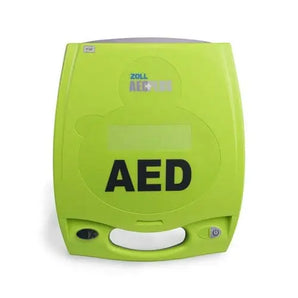
The ZOLL AED Plus remains a practical option for demanding environments where ruggedness, proven performance and real-time CPR feedback are important. You can review the ZOLL AED Plus package for more information.
The goal is not to buy the most expensive AED. It is to choose the right AED based on the complete picture—not simply the lowest advertised price.
Questions to ask before buying an AED in Canada
Before placing an order, ask the supplier:
-
How does this AED guide an inexperienced rescuer?
-
Does it provide real-time feedback on CPR quality?
-
How is the device changed from adult to child mode?
-
Are separate pediatric pads required?
-
What are the pad and battery shelf lives and replacement costs?
-
What shock-energy levels can the AED deliver?
-
Can the voice prompts be heard in a noisy environment?
-
Does it provide English and French operation?
-
Can its readiness be monitored remotely?
-
What warranty, technical support and maintenance services are included?
A knowledgeable AED supplier should be able to explain these differences clearly and recommend a device based on your needs—not simply on what is easiest to sell.
Frequently asked questions
Should I buy the cheapest AED available?
Not without comparing its technology, ease of use, consumable costs, warranty and support. A lower purchase price can be attractive, but a newer AED with longer-life supplies or better rescue guidance may provide better long-term value.
Are older Philips and Defibtech AEDs still usable?
An older AED may remain usable when it is supported by the manufacturer, passes its self-tests and has correctly installed, unexpired pads and a serviceable battery. However, older platforms may lack modern capabilities such as real-time CPR feedback, adaptive voice volume, simplified adult-and-child operation or connected readiness monitoring. Have an AED specialist assess an aging device before deciding whether to keep or replace it.
Does a higher-joule AED always provide a better outcome?
No. Shock energy is only one part of AED performance, and an AED should determine whether a shock is appropriate. The LIFEPAK CR2's ability to escalate to 360 joules is a feature worth considering, but it does not guarantee a particular outcome.
What is the most important feature in an AED?
The most important requirement is that the AED is appropriate for its environment, easy for a rescuer to operate and maintained in rescue-ready condition. CPR feedback, bilingual prompts, pediatric functionality, energy capability, durability and connectivity may become priorities depending on the location.
Do not let price make the entire decision
Budget matters, but an AED purchase should be evaluated as a long-term life-safety investment. Buying solely on price can mean accepting older technology, less rescue guidance, shorter-life consumables or features that do not match your facility.
AED.ca can help you compare current AED models, understand their lifetime maintenance costs and choose the right device for your workplace, school, church, recreation facility, healthcare setting or public space. Contact AED.ca for straightforward guidance or browse AEDs available in Canada.
About AED.ca and Martin Andrews
AED.ca is a Canadian-owned AED specialist providing automated external defibrillators, replacement pads and batteries, accessories and full-service maintenance programs to organizations across Canada. AED.ca focuses exclusively on helping customers select dependable equipment and keep it rescue-ready.
Martin Andrews is the President of AED.ca and works with Canadian businesses, schools, healthcare providers, community organizations and public facilities to make AED ownership simpler and more dependable.