Ontario Construction-Site AED Requirements: What Construction Companies Need to Know in 2026
As of January 1, 2026, many Ontario construction projects are legally required to have an Automated External Defibrillator (AED) installed, maintained and ready for use.
Under section 27.1 of Ontario Regulation 213/91, an AED is required when 20 or more workers are regularly employed at a construction project and the work is expected to last at least three months.
Simply purchasing an AED is not enough. Construction companies must also properly store the AED, provide the required rescue supplies and signage, conduct documented quarterly inspections, maintain and test the device according to the manufacturer’s instructions, and ensure a trained worker is present whenever work is underway.
AED.ca can help construction companies select the right AED, supply the required accessories and signage, establish an inspection system, maintain the equipment and produce the documentation needed to demonstrate that the AED is being properly managed.
Which Ontario construction projects require an AED?
Ontario’s construction-site AED requirement applies when:
-
Twenty or more workers are regularly employed at the project; and
-
The construction work is expected to last three months or longer.
The regulation places responsibility on the constructor to ensure that the AED is installed and maintained and that the other requirements of section 27.1 are met.
Even when a smaller or shorter project does not meet these thresholds, having an AED available remains an important safety measure. Sudden cardiac arrest can affect someone of any age and may occur without warning.
You can review the official requirements in Ontario Regulation 213/91.
What AED equipment is required?
The AED used on the construction project must be licensed as a medical device by Health Canada.
The following rescue supplies must also be stored with the AED:
-
One CPR mask
-
One pair of scissors
-
Two pairs of disposable medical-grade gloves
-
One disposable razor
-
One garbage bag
-
Four absorbent towels
These supplies must be maintained and replenished when necessary.
AED.ca can supply construction companies with Health Canada-licensed AEDs, carrying cases, cabinets, wall brackets, AED signs, replacement pads, batteries and the supporting rescue supplies needed to create a complete construction-site AED station.
Construction companies can browse AEDs available from AED.ca or contact our team for help choosing the most suitable model for a particular job-site environment.
Where must the AED be stored?
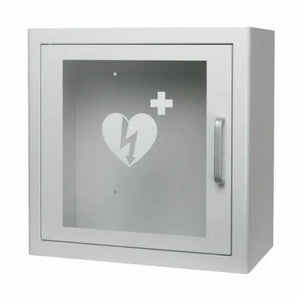
A construction-site AED and its required supplies must be stored together in a suitable location.
The storage area must:
-
Protect the AED and supplies from dust, moisture and other potentially damaging substances
-
Remain unobstructed
-
Allow workers to access the AED easily
-
Be clearly identified with the required signage
-
Protect the AED from extreme temperatures, moisture and direct sunlight when stored outdoors
This requirement is especially important on construction sites. Dust, water, dirt, vibration, heat and freezing temperatures can damage an AED or its accessories.
An AED should not simply be left inside an unheated job trailer, service vehicle or outdoor cabinet without confirming that the storage conditions meet the device manufacturer’s specifications. Ontario winters and summer heat can expose an AED to temperatures outside its approved storage range.
AED.ca can help determine the appropriate cabinet, bracket, carrying case or protected location for each project. We can also help companies decide whether the AED should be moved as the project develops so it remains visible, accessible and properly protected.
What signage is required?
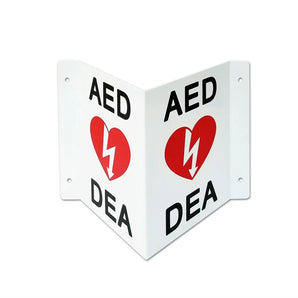
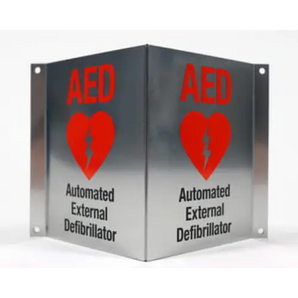
The AED’s location must be clearly identified by signage placed next to the device and at other appropriate locations throughout the construction project.
The sign must include:
-
A heart containing a lightning-bolt symbol; and
-
The words “Automated External Defibrillator,” “AED,” “Défibrillateur externe automatisé” or “DEA.”
Directional signage may also be needed across larger or multi-level projects so workers can locate the AED without delay.
AED.ca supplies highly visible AED signs and can help construction companies determine where signage should be installed.
What are the AED inspection and maintenance requirements?
Ontario Regulation 213/91 requires construction-site AEDs to be:
-
Maintained and tested according to the manufacturer’s instructions; and
-
Inspected at least quarterly by a competent worker in accordance with the manufacturer’s instructions.
A written inspection record must remain with the AED and include:
-
The date of each inspection
-
The name of the competent worker completing the inspection
-
The worker’s signature
The quarterly inspection is not optional. An AED that is mounted on a wall but not inspected, documented and properly maintained may not meet the requirements.
More importantly, it may not work when someone’s life depends on it.
What should be checked during an AED inspection?
The exact inspection procedure depends on the AED manufacturer and model, but a proper check will generally confirm that:
-
The AED is present in its designated location
-
The location remains accessible and unobstructed
-
The AED’s readiness indicator shows that it is operational
-
The unit has not been physically damaged
-
The electrode pads are sealed, connected where required and within their expiry date
-
The battery has adequate capacity and is within its recommended service life
-
The required rescue supplies are present and usable
-
Nothing has been removed from the rescue kit
-
The cabinet, case, bracket and signage remain secure and visible
-
The AED is being stored within the manufacturer’s approved environmental conditions
-
The inspection has been dated, signed and recorded
AED pads and batteries have limited service lives. Pads can dry out and may not adhere properly after their expiration date. Batteries can lose capacity, even when the AED has never been used.
Construction companies must also respond promptly to warning indicators, fault messages, failed self-tests, damaged equipment or missing supplies.
How AED.ca supports construction companies
AED.ca provides more than an AED in a box. We can help construction companies establish and manage a complete AED program across one project or multiple job sites.
1. Selecting the right construction-site AED
Not all AEDs offer the same durability, pad life, battery life, CPR feedback or maintenance features.
AED.ca can recommend a Health Canada-licensed AED based on:
-
The project environment
-
Indoor or outdoor placement
-
Temperature and storage conditions
-
Expected project duration
-
Number of workers
-
Portability requirements
-
Bilingual requirements
-
Ongoing maintenance costs
-
Whether the AED will move to another project after completion
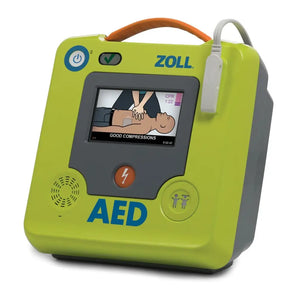
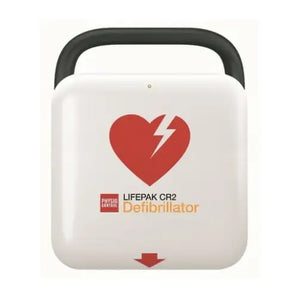
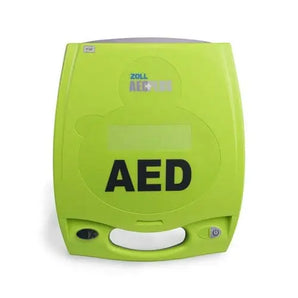
AED.ca carries leading models from ZOLL and Stryker/Physio-Control, including the ZOLL AED Plus, ZOLL AED 3 and LIFEPAK CR2.
2. Complete AED packages
AED.ca can provide a complete package that includes the AED, rescue supplies, signage and appropriate storage equipment.
This helps construction companies avoid purchasing an AED while overlooking another component required for a properly equipped and clearly identified AED station.
Here is AED.ca's Recommended AED Construction AED Package:
AED for Construction Companies Package
3. Inspection systems and compliance records
AED.ca can help establish a repeatable inspection process for the competent worker responsible for the required quarterly checks.
Our digital tracking and reporting tools can help companies:
-
Record AED inspections
-
Track pad and battery expiry dates
-
Maintain a service history
-
Document the condition of the AED
-
Create centralized records for multiple projects
-
Receive reminders before supplies expire
-
Produce audit-ready maintenance documentation
NFC or QR-enabled TapReport tags can make it easier for an authorized worker to access the inspection form at the AED and document the check while physically standing in front of the unit.
The constructor remains responsible for ensuring every legally required quarterly inspection is completed by a competent worker. AED.ca helps make that process easier to organize, document and verify.
4. Professional AED inspections
The quarterly construction-site inspection should not be confused with a comprehensive professional AED inspection.
AED.ca’s professional inspection service can provide a more detailed assessment of the AED, pads, battery, accessories, storage conditions, signage and maintenance history. This creates an additional level of oversight beyond routine site checks.
Where required, AED.ca can work with the construction company to develop an inspection schedule suited to the duration and needs of the project.
5. Full-Service AED Maintenance Plans
AED.ca’s Full-Service AED Maintenance Plans are designed to reduce the administrative burden of managing life-saving equipment.
Depending on the plan and equipment, support can include:
-
Professional on-site inspection and certification
-
Maintenance and inspection records
-
Automatic pad and battery replacement before expiry
-
Digital equipment and service history
-
Expiration reminders
-
Centralized reporting
-
Priority support
-
Assistance following an AED use
-
Access to a loaner AED when applicable
When a project is completed, AED.ca can also help inspect and prepare the AED before it is transferred to another construction site.
AED.ca Full Service Maintenance Plan
A trained worker must be present
Whenever work is in progress, the regulation requires at least one worker trained in CPR and AED operation to be present at the project.
Because crews, shifts and subcontractors can change, construction companies should ensure their staffing plan always provides trained coverage—not merely that one person connected to the project has completed a course.
The AED’s location and emergency response procedure should also be included in site orientations and communicated to workers and subcontractors.
WSIB may reimburse up to $2,500
Eligible Ontario construction businesses may qualify for reimbursement of up to $2,500 toward the cost of one AED for every qualifying construction project.
According to the WSIB:
-
The reimbursement program opened January 1, 2026
-
AEDs purchased between July 1, 2025, and June 30, 2027, may be eligible
-
The final date to submit a reimbursement request is July 31, 2027
Eligibility conditions apply. Construction companies should review the current requirements directly through the WSIB AED Reimbursement Program before purchasing or submitting an application.
Keep the purchase invoice, product information and project records needed to support the reimbursement request.
Compliance involves more than buying an AED
An AED cannot protect workers if it is inaccessible, exposed to damaging conditions, missing supplies or equipped with expired pads or a depleted battery.
Ontario’s construction regulation recognizes that an effective AED program requires several connected elements:
-
A Health Canada-licensed AED
-
Required rescue supplies
-
Suitable, protected storage
-
Clearly visible signage
-
A trained worker on site
-
Quarterly inspections by a competent worker
-
Signed inspection records kept with the AED
-
Maintenance and testing according to the manufacturer’s instructions
Missing any one of these elements can create a gap in both emergency preparedness and regulatory compliance.
Let AED.ca help keep your construction sites prepared
Whether your company needs one AED for a single project or a standardized program across numerous construction sites, AED.ca can help.
We provide:
-
Health Canada-licensed AEDs
-
Construction-site AED packages
-
Cabinets, brackets and carrying cases
-
Required rescue supplies
-
AED signage
-
Replacement pads and batteries
-
Inspection and maintenance support
-
Digital inspection records
-
Multi-location AED management
-
Full-Service AED Maintenance Plans
-
Post-use support and replacement supplies
Call 1-833-428-3233, email info@aed.ca, or contact AED.ca to request a construction-site AED quote or discuss an inspection and maintenance program.
AED.ca is Canada’s AED Company—helping construction companies keep their AEDs visible, documented, compliant and Rescue Ready.
This article provides general information and is not legal advice. Construction companies should review Ontario Regulation 213/91 and obtain professional advice when determining how the requirements apply to a particular project.